
The Content Collapse: What Happens When the Internet Forgets What's Real
More than half of new online articles are now AI-generated, and AI search tools get news citations wrong over 60% of the time. The strange counterweight: psilocybin, connectedness, and real people telling the truth again.
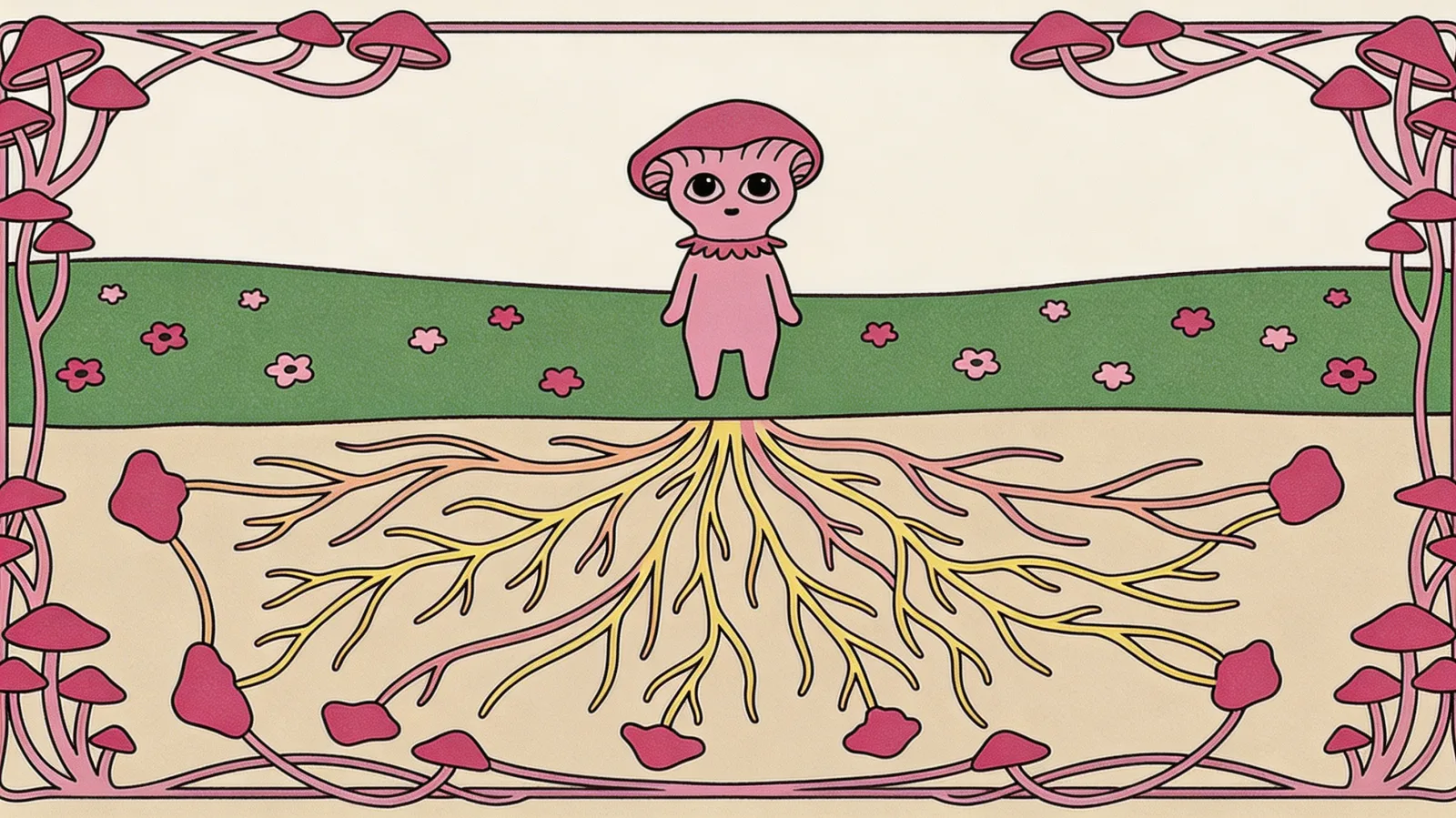
The weirdest thing about the psychedelic renaissance is that it is happening at the exact moment the internet is forgetting how to be human.
Not slowly. Not poetically. More like a Costco forklift backing over the public record while a chatbot says, “I found this helpful summary for you.”
Depending on which study you read, roughly half of new online articles now carry detectable AI fingerprints. Search engines are answering questions with the confidence of a guy at a party who skimmed one headline in 2019. Brands are publishing content nobody wrote, for readers who may not exist, so machines can summarize it for other machines. Somewhere in that loop, a human being is supposed to feel informed.
Good luck.
And then, down in the dirt, literally, there is this other thing happening. People are turning toward mushrooms. Toward psilocybin, microdosing, plant medicine, integration circles, old questions, honest conversations, and the deeply unsexy practice of paying attention to your own life.
That is the interrupt.
The internet is becoming more synthetic. The mushroom keeps asking you to become more real.
The mushroom is the door.
The content collapse is already here
The cleanest way to understand the internet in 2026 is this: we are no longer drowning in information. We are drowning in simulated information.
Graphite’s research on online articles found that by early 2026, approximately half of newly published online articles carried primarily AI-generated content — a sharp increase from roughly 10% in 2022. That is not “some blogs are using ChatGPT for outlines.” That is a fundamental shift in who, or what, is producing the written web.
Ahrefs found an even sharper signal in new content. In an April 2025 study of 900,000 newly detected English-language pages (one per domain), 74.2% contained AI-generated content, with only 25.8% appearing to be purely human-written. The study relied on AI detection tools, which have known limitations — false positives and negatives are real — but the direction of the trend is hard to dismiss.
Sit with that for one second. Three out of four new English pages touched by AI. The fresh internet smells like a robot wrote a book report about a podcast it did not listen to.
Some of this content is fine. AI-assisted writing can be checked and made useful by actual people with actual domain knowledge. Tools are tools. A chainsaw can cut firewood or make your garage look like a crime scene.
The problem is the absence of an accountable human. No judgment. No lived experience. No taste. No one standing behind the sentence when the sentence turns out to be wrong. No nervous system that knows embarrassment.
That is when content becomes slop.
AI search has a citation problem
The obvious comeback is: “Fine, websites are messy. AI search fixes it.”
That would be adorable if it were true.
In March 2025, Columbia Journalism Review’s Tow Center for Digital Journalism tested eight AI search engines across 1,600 queries. The study focused specifically on whether AI search tools could correctly retrieve and cite news content — identifying the right article, publisher, date, and URL from news excerpts. Collectively, the tools gave incorrect answers to more than 60% of queries.
More than sixty percent.
Not a rounding error. Not a weird edge case involving a Romanian chess blog from 2007. The tools struggled with basic news retrieval across mainstream AI search products. Perplexity had the lowest failure rate, around 37%. One tool failed 94% of the time.
The Tow Center also found something more unsettling: premium models were often more prone to confident incorrectness. In plain English, the more expensive robot did not necessarily become more accurate. It just became more convincing while being wrong.
A normal search result can be annoying. You click, compare sources, decide what looks credible, and hopefully notice when something feels off. AI search compresses that process into a single answer. It removes friction, which feels magical, but some friction is the point. Friction is where discernment lives.
When a chatbot gives you a clean answer with a broken citation, it does not feel like misinformation. It feels like convenience.
That is how reality gets laundered.
Google is quietly telling us what still works
Semrush analyzed 20,000 keywords and 42,000 blog posts and found that purely AI-generated content appeared in Google’s number one position just 9% of the time. Human-written content held the top spot 80% of the time.
That does not mean Google has solved AI slop. It has not.
But the finding points to a pattern: human content still wins when the question requires experience, judgment, originality, or trust. Search engines are not perfect arbiters of quality, but their ranking systems reward what synthetic content struggles to produce — genuine authority, original framing, and evidence of someone who actually knows what they are talking about.
Google’s own Search Central guidance, in its documentation on optimizing for generative AI features, warns publishers: “Don’t just recycle what others on the internet have already said, or could easily be produced by a generative AI model.”
That line says the commodity layer is dying. The generic explainer, the recycled listicle, the “ultimate guide” assembled from twelve other ultimate guides, the SEO casserole with no cook in the kitchen. All of it is becoming less valuable because machines can produce infinite versions of it.
The scarce thing now is not content.
The scarce thing is contact.
A real point of view. A real person. A lived pattern. A scar. A field note. A detail that could only come from someone who was there, paid attention, and had enough backbone not to sand the truth into beige paste.
This is where the psychedelic conversation gets interesting.
Psilocybin’s real mechanism is not surface-level positivity
The worst version of the psychedelic internet makes psilocybin sound like a mood ring with spores.
“Become a wizard by lunch. Unlock your inner moon accountant. Make your aura’s Wi-Fi stop buffering by Thursday.”
Nope. Hard pass. Put the quartz funnel down.
The serious research is stranger, cleaner, and more useful than that.
Robin Carhart-Harris and the Imperial College London research group helped bring psilocybin back into modern neuroscience. Their work on the Default Mode Network, brain entropy, emotional processing, and depression is foundational to the field. One of the most human findings from that research line came through patient reports after psilocybin sessions in Imperial’s clinical depression studies.
In a 2018 paper titled “Psychedelics and connectedness,” Carhart-Harris and colleagues argued that connectedness may be a central psychological mechanism of psychedelic-assisted clinical work. That argument grew from patient accounts (Watts et al., 2017), where twenty people in an open-label psilocybin trial described a shift from disconnection to connection: connection to self, connection to others, and connection to the world.
Not a miracle claim. Not “mushrooms make depression disappear.” The work was an open-label study with twenty participants and qualitative interviews. Modest by design.
But the pattern is hard to ignore.
The people who described the largest shifts were not simply reporting a better mood. They were reporting reconnection.
They could feel themselves again. They could relate to other people again. The world stopped feeling like a dead interface and started feeling like something they were inside of.
If you have spent enough time online, that sentence should land with a small thud.
AI slop is the symptom. Disconnection is the deeper pattern.
AI slop is easy to make fun of because it is often funny in a bleak way. The fake recipes. The hallucinated legal cases. The articles with twelve introductions and no pulse. The LinkedIn posts where every founder has discovered the same “uncomfortable truth” at 6:12 a.m.
But slop is not the root problem. Slop is a symptom.
The deeper pattern is disconnection.
Disconnection from the body, so everything becomes an idea. Disconnection from community, so every belief becomes a private algorithmic weather system. Disconnection from direct experience, so we outsource our sense of reality to feeds, rankings, summaries, and synthetic consensus.
The internet did not invent this. It just industrialized it.
AI accelerated the industrial part. Now the machine can produce infinite content that looks like meaning from a distance. It has structure. It has citations, sometimes fake ones. It has a calm voice. It has no nervous system.
That last part matters.
A nervous system knows embarrassment, grief, doubt, humor, hunger, love, and the weird little moral nausea you get when you are about to lie politely. AI predicts language about those things. Sometimes beautifully. Sometimes usefully. But it does not know them.
The clinical research on psilocybin suggests something relevant here. In controlled therapeutic settings, psilocybin appears to help some people reconnect with felt experience — to notice what is actually happening in the body, to see rigid self-narratives from a slightly different angle, to find old emotional patterns less compulsory. The Imperial College and Johns Hopkins research programs have documented versions of this across multiple studies. It is not universal. It is not guaranteed. It is not a personality upgrade.
But the direction of the effect is worth noticing: toward contact, toward presence, toward the thing that was there before the story took over.
If you are using mushrooms to avoid your life, the mushroom will eventually hand your life back to you with interest. That is the job.
The practice is strangely suited to a synthetic age
There is a reason psilocybin keeps showing up in this cultural moment.
Many people report that extended immersion in digital environments leaves them feeling disconnected — from their bodies, from other people, from a felt sense of what matters. Scroll long enough and you become a pair of eyes attached to a thumb. Your attention gets chopped into saleable pieces. Your opinions get pre-loaded by whatever package the algorithm shipped that morning.
Psychedelic practice, when done well and with appropriate support, moves in the opposite direction.
It asks: What is happening in your body? What are you avoiding? Who do you need to talk to? What is the pattern beneath the pattern? What did you stop feeling because feeling it would force a decision?
This is not mystical. It is practical.
A 2019 randomized controlled trial by Smigielski and colleagues found that psilocybin administered during a five-day mindfulness retreat modulated self-consciousness and Default Mode Network connectivity in ways that were associated with positive psychosocial changes four months later. These are the same DMN regions that Brewer and colleagues found, in a 2011 cross-sectional study, showed reduced activity in long-term meditators.
Different methods. Similar direction. Less compulsive self-looping. More contact with present experience.
The point is not to replace the internet with mushrooms. Please do not build that startup. I can already see the pitch deck and I hate it.
The point is that a culture that increasingly produces synthetic content — and synthetic disconnection — makes reconnection practices more valuable, not less. If the feed is designed to fragment attention, you need practices that rebuild attention. If AI search can confidently misstate reality, you need practices that strengthen discernment. If content is increasingly generated without lived experience, you need communities where lived experience is the whole point.
Why MCRDSE is built around people, not content
This is why a movement matters more than a media library.
We care about research. We care about protocols, safety boundaries, integration, and the difference between a microdose and a bad decision with branding. But the real layer is people.
People comparing notes without pretending their anecdote is a clinical trial. People saying, “This helped,” and also, “This part was hard,” and also, “I think I used the practice to avoid a conversation I needed to have.” People with enough honesty to make the room useful.
That kind of community is difficult to fake because it requires consequences. If you tell a polished lie in a real community, someone eventually feels the gap. If you pretend the practice is all ease and no mess, somebody who is in the mess will know you are selling them a screensaver.
To be clear: human rooms are not automatically truthful. Communities can amplify misinformation, groupthink, and charismatic overconfidence just as easily as algorithms can. What makes a community useful is not that it’s human — it’s that it commits to norms. Honesty about limits. Willingness to say “I was wrong.” The habit of asking “what’s your actual experience?” instead of “what’s your opinion about the thing you read?”
The internet can generate infinite articles about microdosing. It cannot generate your Tuesday morning after the dose, the note you wrote in the margin, the conversation you finally had, the walk where your brain stopped arguing with itself for twelve minutes.
That is the material.
That is why real people sharing real experiences matter more now, not less. The more synthetic the public internet becomes, the more valuable human rooms become. Not because humans are always right. We are absolutely not. We invented crypto mascots and gender reveal explosives. Our record is mixed.
But humans can be accountable to each other. Humans can repair. Humans can say, “I was wrong.” Humans can notice when the story is too clean.
Machines can summarize reality. Communities can test it.
FAQ
Is AI-generated content always bad?
No. AI-assisted content can be useful when a real person brings expertise, checks the facts, edits for clarity, and takes responsibility for the final piece. The problem is low-accountability AI slop: content with no lived experience, no source checking, no original thinking, and no human standing behind it.
Are AI search engines reliable for psychedelic or microdosing research?
Use them cautiously. The Tow Center study found that AI search engines failed to correctly retrieve and cite news articles more than 60% of the time — and that study tested news retrieval specifically, not the harder question of health or medical accuracy. For topics like psilocybin, microdosing, psychiatric medications, or mental health history, always verify claims against primary research, credible medical sources, or qualified professionals. AI search can be a starting point. It should not be the endpoint.
Does psilocybin create connectedness?
Controlled clinical research from Imperial College London and Johns Hopkins suggests that people in psilocybin studies often report increased connectedness to self, others, and the world. The evidence is strongest in full-dose therapeutic or retreat settings. The effect at microdose levels is less studied. Context matters: dose, preparation, support, integration, and personal risk factors all shape the outcome.
Why does community matter for microdosing?
Microdosing is subtle, and subtle practices are easy to misread in isolation. A grounded community helps people compare patterns, notice blind spots, and stay honest about limits. Community advice is not medical advice, and peer reports can mislead — good communities build norms around that reality rather than pretending it doesn’t exist.
Sources
- Graphite. Research on AI-generated content in online articles. Estimates that by Q1 2026, approximately 50% of newly published online articles carried primarily AI-generated content, up from roughly 10% in 2022. https://graphite.com
- Ahrefs. “74% of New Webpages Include AI Content (Study of 900k Pages).” April 2025. Study of 900,000 newly detected English-language pages (one per domain) using AI detection tools. 74.2% contained AI-generated content; 25.8% purely human. https://ahrefs.com/blog/what-percentage-of-new-content-is-ai-generated/
- Columbia Journalism Review, Tow Center for Digital Journalism. “AI Search Has a Citation Problem.” March 2025. Tested eight AI search engines across 1,600 queries for news article retrieval and citation accuracy. Incorrect answers in more than 60% of queries. Perplexity: ~37% failure rate; Grok-3 Search: ~94% failure rate. https://www.cjr.org/tow_center/we-compared-eight-ai-search-engines-theyre-all-bad-at-citing-news.php
- Semrush. “Does AI content rank well in search?” Analyzed 20,000 keywords and 42,000 blog posts. Purely AI-generated content in Google’s #1 position: 9%. Human-written content: 80%. https://www.semrush.com/blog/does-ai-content-rank-in-search-data-study/
- Google Search Central. “Optimizing your website for generative AI features on Google Search.” Guidance warning against recycling content easily produced by generative AI. https://developers.google.com/search/docs/fundamentals/ai-optimization-guide
- Watts, R., Day, C., Krzanowski, J., Nutt, D., & Carhart-Harris, R. (2017). “Patients’ accounts of increased ‘connectedness’ and ‘acceptance’ after psilocybin for treatment-resistant depression.” Journal of Humanistic Psychology, 57(5), 520–564. DOI: 10.1177/0022167817709585
- Carhart-Harris, R. L., Erritzoe, D., Haijen, E., Kaelen, M., & Watts, R. (2018). “Psychedelics and connectedness.” Psychopharmacology, 235, 547–550. DOI: 10.1007/s00213-017-4701-y
- Smigielski, L., Scheidegger, M., Kometer, M., & Vollenweider, F. X. (2019). “Psilocybin-assisted mindfulness training modulates self-consciousness and brain default mode network connectivity with lasting effects.” NeuroImage, 196, 207–215. DOI: 10.1016/j.neuroimage.2019.04.009
- Brewer, J. A., Worhunsky, P. D., Gray, J. R., Tang, Y. Y., Weber, J., & Kober, H. (2011). “Meditation experience is associated with differences in default mode network activity and connectivity.” Proceedings of the National Academy of Sciences, 108(50), 20254–20259. DOI: 10.1073/pnas.1112029108
The Microdose Movement is an educational community, not a medical provider. Nothing in this article is medical advice. Psilocybin remains regulated differently depending on where you live. If you have a personal or family history of psychosis, bipolar disorder, or severe mental health instability, talk with a qualified professional before engaging with psychedelic practices. The clinical research cited in this article was conducted in controlled therapeutic or retreat settings with screening and support. Microdosing is a different context. Do not assume findings from one setting automatically apply to the other.